

Introduction
Completing a PGCE (Postgraduate Certificate in Education) is a major milestone.
But after finishing your qualification, many graduates ask:
What comes next?
Can you only become a classroom teacher?
Are there international opportunities?
Can PGCE lead to leadership or specialized education careers?
The answer is far broader than many people realize.
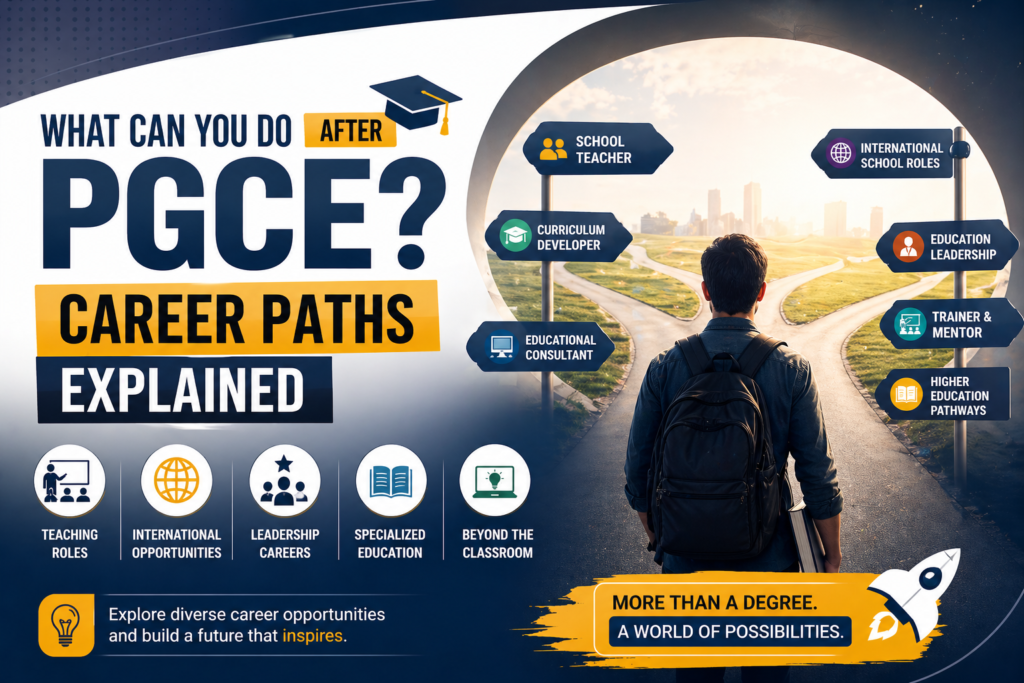
A PGCE is not simply a route into teaching — it can be a gateway into multiple career paths in education, leadership, training, curriculum development, and global opportunities.
In this guide, we explore the major career paths you can pursue after PGCE and where this qualification can take you in 2026 and beyond.
What Does a PGCE Qualify You For?
A PGCE prepares you with:
- Professional teaching skills
- Classroom management experience
- Lesson planning expertise
- Educational theory and practice
- School placement experience
This foundation opens doors to far more than one career option.
1. Become a Primary School Teacher
One of the most common routes after PGCE is primary teaching.
You may work with younger learners developing foundational skills in:
- Literacy
- Numeracy
- Science
- Social learning
- Personal development
Career Opportunities
- Public schools
- Private schools
- International schools
- British curriculum schools abroad
Why Many Choose It
- High demand
- Meaningful impact
- Long-term career growth
For many graduates, this is the natural first step.
2. Become a Secondary School Teacher
If your PGCE is subject-based, secondary education can offer strong opportunities.
Common teaching subjects include:
- Mathematics
- English
- Biology
- Chemistry
- Physics
- Computer Science
- History
- Geography
Career Path Potential
Teacher → Senior Teacher → Head of Department → School Leadership
This route can offer both specialization and progression.
3. Teach in International Schools
This is one of the most attractive paths after PGCE.
British curriculum schools operate globally.
High-demand regions include:
- UAE
- Saudi Arabia
- Qatar
- Oman
- Singapore
- Malaysia
- Europe
International schools often value:
- UK training
- PGCE qualifications
- British teaching methodology
Benefits
- Competitive salaries
- International lifestyle
- Career growth
- Global mobility
For many international students, this is a major goal.
4. Work Toward Qualified Teacher Status (QTS) Opportunities
Depending on your route, PGCE may support progression toward roles requiring or valuing QTS.
This can strengthen opportunities in:
- UK teaching roles
- International schools
- Higher-paying positions
Many graduates see this as a major career advantage.
5. Become a SEN / Special Education Teacher
Special Education is a growing field.
You may work with students needing support in areas such as:
- Learning difficulties
- Autism support
- Inclusive education
- Additional learning needs
Demand in this field continues rising.
And many educators find it highly rewarding.
6. Move Into Education Leadership
Teaching can evolve into leadership.
Possible pathways:
Head of Department
Lead academic teams.
Academic Coordinator
Manage curriculum and teaching quality.
Assistant Principal / Vice Principal
Move into school administration.
Principal / School Leadership
Long-term progression pathway.
Many education leaders began with PGCE.
7. Become a Curriculum Developer
Not everyone wants lifelong classroom teaching.
Some move into curriculum work.
Possible roles:
- Curriculum Specialist
- Instructional Designer
- Education Content Developer
- Assessment Designer
Responsibilities may include:
- Designing learning materials
- Building syllabi
- Creating educational programs
- Developing assessments
This field is growing rapidly.
8. Work in Educational Consulting
PGCE can support consulting-related careers.
Possible roles:
- Academic consultant
- Education advisor
- School improvement consultant
- Teacher trainer
You may support:
- Schools
- Institutions
- NGOs
- Education companies
This path often combines education and strategy.
9. Become a Teacher Trainer
Experienced PGCE graduates often move into training other teachers.
Possible work includes:
- Teacher professional development
- Workshop facilitation
- Instructional coaching
- Teacher mentoring
This can be a natural progression after classroom experience.
10. Move Into Educational Technology (EdTech)
One of the fastest-growing sectors.
PGCE graduates increasingly enter EdTech.
Possible roles:
- Learning designer
- EdTech specialist
- Online course developer
- Academic product specialist
Education and technology are merging rapidly.
This field is growing globally.
11. Work in Higher Education
Some PGCE graduates move into colleges or higher education support roles.
Possible areas:
- Lecturer pathways (with further study)
- Academic support
- Student development
- Education research
PGCE can support progression toward advanced academic roles.
12. Continue Into Further Study
PGCE can also be a stepping stone.
Further study options:
Master of Education (M.Ed)
Focus areas:
- Educational leadership
- Curriculum studies
- Policy
- Inclusion
Educational Leadership Degrees
For administration-focused careers.
Doctoral Study
Potential route into research or academia.
PGCE does not have to be the final qualification.
13. Work in NGOs and Development Education
Many graduates overlook this path.
Education-focused organizations often hire professionals with teaching backgrounds.
Possible sectors:
- Education development
- Child advocacy
- Refugee education
- Community learning programs
This can be impactful and purpose-driven work.
Can PGCE Lead to International Careers?
Absolutely.
One major strength of PGCE is mobility.
Graduates may pursue opportunities across:
- UK
- Middle East
- Europe
- Asia
- International schools worldwide
This global flexibility is a major reason students choose PGCE.
Career Progression After PGCE
A possible progression may look like:
Year 1–3
Classroom Teacher
Year 4–6
Senior Teacher / Specialist Roles
Year 7–10
Leadership / Curriculum / International Roles
Beyond 10 Years
School Leadership / Consulting / Advanced Education Roles
Teaching careers can evolve significantly.
What Careers Are in Highest Demand After PGCE?
Strong-demand paths include:
- STEM Teachers
- Special Education
- International School Teachers
- Computing Teachers
- Primary Education
- Education Leadership
- EdTech Roles
Demand can vary by region, but opportunities remain strong.
How Much Can You Earn?
Earnings vary depending on:
- Country
- School type
- Experience
- Subject specialization
- Leadership level
Generally, salaries may increase through:
- Experience
- International schools
- Leadership roles
- Specialist expertise
Career growth often improves earnings over time.
Which Career Path Is Best After PGCE?
It depends on your goals.
Choose classroom teaching if you love:
- Working directly with learners
- School environments
- Traditional teaching
Choose international schools if you want:
- Global mobility
- Higher salary potential
- International exposure
Choose curriculum or EdTech if you enjoy:
- Innovation
- Content creation
- Educational design
There is no single “best” path.
Only the best path for you.
Is PGCE a Good Long-Term Career Investment?
For many, yes.
Because it can lead to:
- Professional stability
- Global opportunities
- Leadership pathways
- Multiple career options
Few qualifications offer such versatility.
Final Thoughts
So, what can you do after PGCE?
Much more than simply become a teacher.
You can pursue:
- School teaching
- International education
- Leadership
- Curriculum development
- Teacher training
- Educational consulting
- EdTech careers
- Further study
That is what makes PGCE powerful.
It is not a single career path.
It is a platform for many.
And in 2026, those opportunities continue to grow.
FAQs
Can I teach internationally after PGCE?
Yes, many international schools value PGCE-qualified teachers.
Can PGCE lead to leadership roles?
Absolutely, many school leaders began as classroom teachers.
Is PGCE useful outside classroom teaching?
Yes — curriculum, consulting, EdTech and training are examples.
Can I do a master’s after PGCE?
Yes, many graduates continue into advanced study.
Does PGCE have strong career scope?
Yes, career scope is one of its major strengths.
Planning PGCE in 2026?
Research not only the qualification — but the career paths it can unlock. That is where its real value lies.