
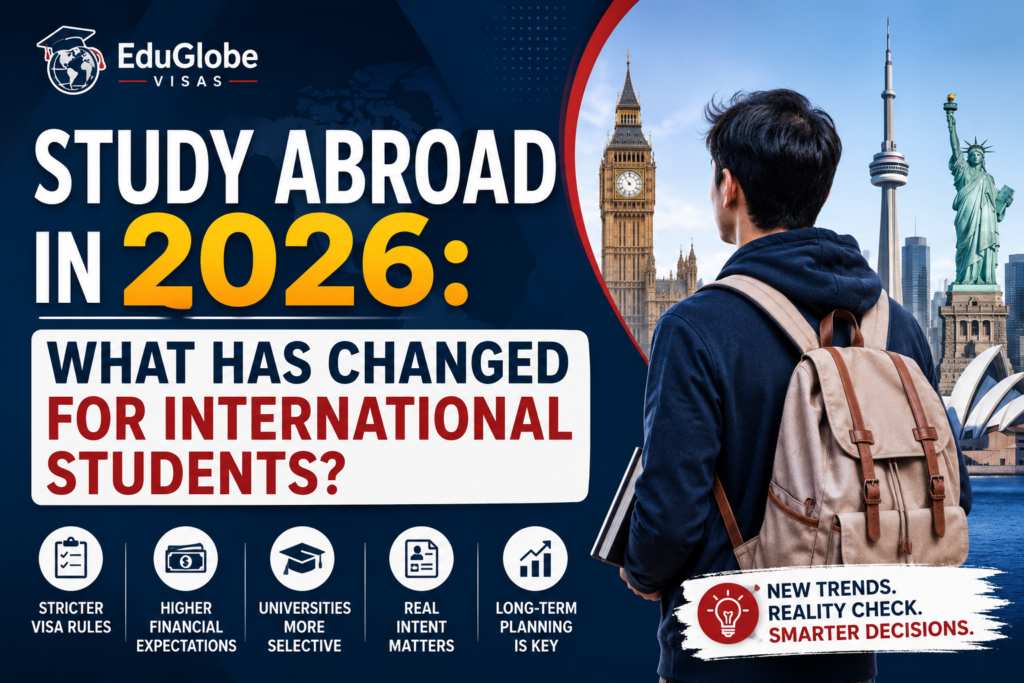
The study abroad landscape in 2026 looks very different compared to just a few years ago. Countries are becoming more selective, universities are focusing more on genuine students, and immigration systems are now placing greater importance on financial credibility, academic alignment, and long-term planning.
For international students, especially from countries like Pakistan, this means one important thing:
Study abroad is no longer about “just getting a visa.”
It is now about making informed, realistic, and strategic decisions.
In this blog, we’ll break down the major changes international students need to understand before planning for the UK, Europe, USA, or Canada in 2026.
1. Universities Are Becoming More Selective
In previous years, many students believed that international admissions were relatively easy if basic requirements were met.
That mindset is changing.
Universities are now paying closer attention to:
- Academic consistency
- Genuine study intentions
- English language ability
- Course relevance
- Career alignment
- Financial preparedness
Institutions are trying to attract students who are academically serious and capable of completing their programs successfully.
This means students can no longer rely on random course selections or weak applications.
What This Means for Students
Before applying, students should ask themselves:
- Does this course actually align with my background?
- Can I explain why I selected this country and university?
- Does my profile make sense academically and professionally?
A strong application is no longer just paperwork — it is a complete story.
2. Financial Expectations Have Increased
One of the biggest changes in 2026 is the increased focus on financial readiness.
Countries now expect students to demonstrate that they can realistically manage:
- Tuition fees
- Living expenses
- Accommodation costs
- Emergency funds
- Long-term sustainability
Many students underestimate the actual cost of studying abroad because of misleading social media content.
The reality is simple:
Studying abroad requires proper financial planning.
Common Mistake
A major mistake students make is assuming that part-time work alone can fully support their education and living expenses.
In most countries, part-time work should be considered support — not the entire financial plan.
Students who plan realistically usually face fewer problems later.
3. Visa Systems Are Becoming More Strict
Governments are now focusing heavily on identifying genuine students.
Because of this, visa applications are being reviewed more carefully than before.
Authorities may now examine:
- Academic history
- Financial transactions
- Study gaps
- Course relevance
- Immigration history
- Intentions after study
This does not mean genuine students cannot succeed.
It simply means students must now prepare properly and avoid shortcuts.
Important Reality Check
A weak profile cannot always be “fixed” through documentation alone.
Good planning should start months before the application process begins.
4. Long-Term Planning Matters More Than Ever
In 2026, students are expected to think beyond just admission approval.
Countries increasingly value applicants who show:
- Clear academic goals
- Realistic career planning
- Logical progression
- Awareness of the education system
Students who apply impulsively often struggle later with:
- Course dissatisfaction
- Financial stress
- Academic pressure
- Career uncertainty
The best decisions are usually made when students think long-term instead of emotionally.
5. English Language Requirements Are More Important
English proficiency is no longer viewed as a “small formality.”
Universities and visa systems now expect students to demonstrate that they can genuinely study, communicate, and perform academically in English-speaking environments.
Students should clearly understand:
- IELTS requirements
- English equivalency options
- University-specific language rules
- Interview communication expectations
Poor communication ability can create challenges even after admission approval.
6. Students Are Becoming More Aware
Another major change in 2026 is that students themselves are becoming more informed.
Today’s students are:
- Researching universities independently
- Comparing countries carefully
- Watching educational content online
- Asking deeper questions
- Looking for transparency
This is a positive shift.
Students should avoid making decisions based only on:
- Viral reels
- “Easy visa” promises
- Unrealistic income expectations
- Fear-based marketing
The right guidance should reduce confusion — not create pressure.
7. The UK, Canada, USA & Europe Are No Longer “One-Size-Fits-All”
One of the biggest misconceptions is believing that one country is perfect for everyone.
That is not true.
Each destination suits different students depending on:
- Academic background
- Financial situation
- Career goals
- Family circumstances
- Long-term priorities
For example:
- Some students may benefit more from the UK’s academic structure.
- Others may prefer Europe for affordability and specific programs.
- Some may fit better into the USA’s flexible education system.
- Others may align more realistically with Canadian pathways.
Correct decisions come from compatibility — not trends.
8. Social Media Has Increased Confusion
Social media has made study abroad information more accessible, but it has also increased misinformation.
Many students now compare themselves to edited success stories without understanding the full reality behind them.
This creates unrealistic expectations about:
- Student life
- Part-time work
- Expenses
- Immigration outcomes
- Career opportunities
Students should always remember:
Every profile is different.
Every journey is different.
A responsible decision should never be based on someone else’s viral video.
Final Thoughts
Study abroad in 2026 is still a valuable opportunity for the right students.
But the environment has changed.
Success now depends more on:
- Correct planning
- Honest guidance
- Realistic expectations
- Financial readiness
- Long-term thinking
Students who approach the process seriously and strategically are far more likely to make successful decisions.
The goal should never be “fast approval.”
The goal should be making the correct decision for your future.
As EduGlobe Visas believes:
Clarity over confusion. Guidance over selling.